Friday, February 12, 2010

illustration-#5


Page:76

this passage talks about a man named akiba drummer who was with them in the camp, and he was someone who went around saying he could not do it anymore, and he was too weak. everyone around him tried raising his spirits. This was a good scene to use for the book, because they are all together squished in one room, and then you hear an old man saying he wont make it and he is weak. And yet everyone looks up to him thinking about how he was strong enough to go through everything he went through. This scene was very easy for me to visualize.


illustration-#4


Page: 24
In the book there is a scene where a woman sits in the box cart, in the same corner. Sometimes silent but sometimes very hysterical. She had lost her son and her husband, she was all alone. Sometimes she sat there in silence wondering how she could be separated from her family. other times she would be hysterical crying. A few times she looked through the cracks of the box cart and started screaming FIRE. Everyone stared at her going crazy out of no where, then she would sit and be calm again. This was a power full scene, and i was able to visualize this scene because everything seemed so realistic, this was a very interesting scene to me, because it just showed me how all people are effected, and how they react in different ways.

Illustration-#3


Pages: 16-17
I drew this picture based on the scene in the book, where everyone is standing outside getting ready to get picked up by the box carts to be taken to the concentration camps. as you can see everyone alined has a sack on there back containing things they brought with them that was not taken away by the nazi's. at the beginning of the line you see there chief rabbi, standing there, with a sack on his back and his beard was shaven and he did not look happy. There rabbi was known to have a long beard, and always be happy amongst all the people around him. This passage shows how something this devastating can effect people in horrible ways. Seeing something as little as a rabbi's beard being shaven, is a big deal because that would not happen, if there was no war.


Illustration-#2


page: 105
I think this was such a POWER FULL scene, this were Eli and his father were running to another camp, in the snow. His father was getting weaker and weaker as they were running, and he just gave up. he feel to the ground, and yes, Eli had to witness his fathers life fade, and had to watch the person who was with him through this hard time, die. I think this was the most power full scene in this book, as i am sitting and visualizing it, i was able to just imagine the pain, and the emotions in this scene.

Illustration-#


Page: 12
As you can see in the picture, Eli was at home with his family waiting for his father to come home from a meeting had to go to. When he gets back from the meeting, his face is flushed, he has tears in his eyes and he is worried. Then he says the word "tranformers" the family was very worried. This was the scene where his father found out they were going to be taken to the consentration camps. This is how his family found out, while he was still in the door way. This was a very important scene because this was where his family found out they were going to be taken away to the consentration camp. this one scene sets the whole book. This was a good scene to draw a picture of because when i read this, i visioned the scene in my head, and felt like i was there.

Thursday, February 11, 2010

Scene Setter #6

*Page 105

After running for so long in the cold and heavy snow, they finally reached to Buchenwald. Eliezer's father was finally giving up, he couldn't take it anymore because he was too weak and tired. Seeing his dad like that made him angry, he used every strength in him to let his father know that he couldn't give up now, but after a while he realized that he was only arguing with death that his father had already chosen.
Just sitting there watching his father dye bit by bit, he knew he didn't want to let him go, not now, after all that they had went through together.

Scene Setter #5

*Page 53-54
One day Eliezer had crossed Idek's path when he was mad. Idek starting beating him in the chest, head, and kept throwing him on the ground and picking him up again. He beat him so much until he was covered in blood. After he was done he sent him back to work as if nothing happened.
A lady that he worked with who he thought was French helped clean him up, and spoke in German saying: "Bit your lips, little brother . . . Don't cry. Keep your anger, your hate, for another day, for later. The day will come but not now . . . Wait. Clench your teeth and wait . . ."
After some years he saw that same lady in Paris, and reminded her of that day in Buna when she had helped him after Idek had beat him.
That was a terrible time for Eliezer because he had done nothing to receive such beatings, yet he won't forget that day because he still see the images in his head.

Monica- Summary #7

SUMMARY #7: pages 104-120

The journey to Buchenwald has made Eliezer's father very weak and close to death. Elizer leaves his father so that he could sleep. In the morning, he begins to search for his father, but halfheartedly. Part of Eliezer is thinking that he will be better off if he abandons his father and become concerned only with his survival. However, he finds his father, who is very sick and unable to move. Eliezer brings him soup and coffee, but feels that he should keep the food for himself to keep up his strength. You soon learn that Eliezer’s father continues to approach death. He is infected with an illness called dysentery, which makes him terribly thirsty. It is extremely dangerous to give water to a man with dysentery, but Eliezer gives him water anyways since his father pleads for it every time. The had of the block tells Eliezer that Eliezer should concentrate his energy on his own survival, and not his father's since he is already dying.

The next time the SS patrol the barracks, Eliezer’s father again cries for water, and the SS officer, screaming at Eliezer’s father to shut up, beats him in the head. On January 29, 1945, Eliezer wakes up to find that his father has been taken to the crematory. But instead of feeling sad, he is relieved.

On April 5, with the American army approaching, the Nazis decide to exterminate all the Jews left in the camp. Daily, thousands of Jews are murdered. On April 10, the Nazis decide to evacuate and kill everyone left in the camp. When it seems that all has returned to normal and that the evacuation will proceed as planned, the resistance movement strikes, driving the SS from the camp. Hours later, on April 11, the first American army tank arrives at Buchenwald. Everyone is finally free from the concentration camps. Soon, Eliezer is struck with food poisoning and spends weeks in the hospital. When Eliezer looks at his reflection in the mirror, he is shocked. “From the depths of the mirror, a corpse gazed back at me.”Wiesel writes. Eliezer has been through a lot that he didn’t even recognize his own reflection in the mirror. It was as if there was a completely different person staring back at him in the mirror. :O

THE END!

So guys, what did you think about the book Night? Did you find Eliezer's experience during the Holocaust interesting to read? (:

Scene Setter #4

*Page 34
After Eliezer's father asked him if he remembered Mrs. Schachter in the train... he than remembered a lot of things that he would never forget. He sat there remembering all the things that he saw that he would never forget like; the first night in camp, the smoke, the small faces of the children whose body transformed into smoke, the flames that consumed his faith forever, the nocturnal silence that deprived him for all eternity of the desire to live, those moments that murdered his God and soul and turned his dreams to ashes, those things, even were he condemned to live as long as God himself.
Him being at that camp made him developed these memories that he would never forget because he saw them with his own eyes and it kind of scarred him for life.

Scene Setter #3

*Page 29

When everyone left the wagon, the SS ordered the men to go to the left and the women to go to the right.
That's when Eliezer finally realized that he was going to be separated from his mother and sisters forever and
was to be alone with his father. Being at that place, without his mother and sisters he knew that it wasn't going to
be too good. So he made sure that he stood by his fathers' side the whole time they were going to be there.

Scene Setter #2

*Page 24-28

By this time, the German Army took over, and everyone was to do what they were told. Their were to be
eighty people in each cart. But then, there was Mrs. Schachter who was separated by her husband and two
older sons by mistake. On the third night, as everyone was sleeping, she suddenly started screaming:
"Fire! I see a fire! I see a fire!" At first everyone believed her, but then they soon realized there wasn't a fire.
She continued screaming: "Fire! I see a fire!" but everyone just started to get annoyed. It was as though she was
possessed by some evil spirt.
Time flew by and every now and then she screamed about a fire being there. Everyone was cramped up in a
little car with barely any room,trying to sleep, but because of Mrs. Schachter's random shouts it was making
everyone angry because they couldn't sleep. To keep her quiet, people starting punching her in the head which
could of caused her to die. It kept her quiet for a while, but by the next night, she began to shout again: "The fire,
over there!"
When they finally got to there destination, Auschwitz, Mrs. Schachter broke out again saying: "Jews, look!
Look at the fire! Look at the flames!" Finally there were flames rising from a tall chimney into a black sky.
After all those nights there actually were flames now, so Mrs. Schachter was right after all, but because
of the situation everyone was in; being in a little car with hardly any room, everyone was tired of hearing her.

Scene Setter #1

*Page 6-7

Moishe the Beadle went from one Jewish house to the next telling his story of when he was sent to the Galician forest, near Kolomay. Even though he managed to escape, it was by a miracle. Moishe was not the same after he had came back, because of all the horrible things that he saw and everything that he had went through the joys in his eyes were gone.
He no longer spoke of God or Kabbalah, and only spoke of what he saw because what he saw was horrible, it took over all his memories of before and he needed to inform everyone about it so that they will not have to go through what he saw too.
No one believed him and they thought he was crazy. Moishe actually succeeded in coming back, and he returned to Sighet to tell the people of his near death experience so that they can ready themselves while there was still time.

Wednesday, February 10, 2010

CITATIONS

Here is where I got all of my information for my Auschwitz posts.

http://www.hollow-hill.com/sabina/images/auschwitz-corpses.jpg

http://www.scrapbookpages.com/AuschwitzScrapbook/Tour/Auschwitz1/Auschwitz08.html

http://en.wikipedia.org/wiki/Auschwitz_concentration_camp

http://simplethinking.com/home/auschwitz_1.htm

http://en.wikipedia.org/wiki/Auschwitz_concentration_camp#Auschwitz_I

https://blogger.googleusercontent.com/img/b/R29vZ2xl/AVvXsEg6LnijHxwJ-c-5U0u9WaBJTOyhIgcVWv9S-jEw8L26qA-c6RWLIZwy0nVUHO9M-CkAiZ2aRvr-7Co6zcb6a2erj7VlofK8ngxZx4eqniILc1_3D4LbFINXCyA-xgTm8SxoA6-OiaOdJ-I/s320/Elie+Wiesel+Buchenwald+Concentration+Camp+Holocaust+Survivor.jpg

RESEARCH- Auschwitz III


Here is the final part of Auschwitz, Auschwutz III (a.k.a Monowitz, which was a labor camp, and the largest camp in Auschwitz). 11,000 slave laborers worked at Monowitz. 7,000 inmates worked at various chemical plants and 8,000 worked in mines. Approximately 40,000 prisoners worked in slave labor camps at Auschwitz or nearby. Doctors from Auschwitz II would visit the work camps quite often and select the weak and sick for the gas chambers of Birkenau, (if you don't remember from my last post, Birkenau was the second camp), so many were literally working for their lives under terrible conditions.

The prisoners' day began at 4:30 a.m. with roll call, with 30 minutes allowed for morning ablutions. After roll call, the Kommando, or work details, would walk to their place of work. Often the prisoners would be wearing no more than five striped camp fatigues, no underwear, and wooden shoes without socks, which were not properly fitted and caused great pain. An orchestra often played as the workers marched through the gates. Kapos (remember them from my last blog post?) were responsible for the prisoners' behavior while they worked, and so was an SS escort. The working day lasted 12 hours during the summer, and a little less in the winter. There were no rest periods were allowed. One prisoner would be assigned to the bathrooms to measure the time the workers spent in there. They weren't allowed to spend much time in the bathroom at all. After work, there was an evening roll call. If a prisoner was missing, the others had to remain standing in place until he was either found or the reason for his absence discovered, even if it took hours, even in the freezing cold or burning heat. After roll call, there were punishments, depending on what had happened during the day. After these, the prisoners were allowed to go to their blocks for the night to receive their bread rations and water. Curfew was two or three hours later, the prisoners sleeping in long rows of wooden bunks, lying in and on their clothes and shoes to prevent them from being stolen. (The picture at the beginning of this post shows this. The man circled in red is Elie Wiesel. This was taken at a different concentration camp he spent time in called Buchenwald.)

RESEARCH- Auschwitz II


Alright, here is information about Auschwitz II.


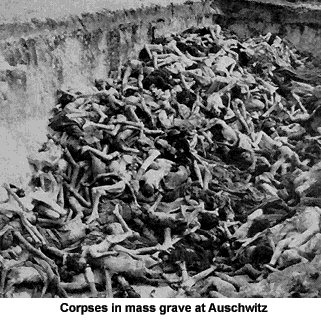
Auchwitz II was the extermination part of the camp, and more then double the size of the main camp. It was created in October of 1941, specifically built for the purpose of killing the prisoners, so that the main camp would not be so crowded. The first gas chamber at Birkenau (a.k.a Auschwitz II) was "The Little Red House." This was a brick cottage converted into a gassing chamber by tearing out the inside and bricking up the walls. It was operational by March 1942. A second brick cottage, "The Little White House," was created very similarly a few weeks later. As I mentioned previously, the first gassings took place in Auschwitz I as an experiment. Afterwards, many chambers were built in Auschwitz II. In early 1943, the Nazis decided to increase the gassing capacity of Birkenau. Crematorium II (located in Birkenau) was originally designed as a mortuary, with morgues in the basement and ground-level furnaces. Later, this was converted into a killing factory by placing a gas-tight door on the morgues and adding vents for Zyklon B (the gas), as well as ventilation equipment to remove the gas. Crematorium III was built using the same design. Crematoria IV and V, which were designed from the start as gassing centers (unlike Crematorium II), were also constructed that spring. By June 1943 all four crematoria were up. Those who worked at these sites were known as Kapos. Generally, the Kapos were convicts. Their job included preparing the victims for gassing by ordering them to remove their clothing and give them their personal possessions. They also transferred corpses from the gas chambers to the furnaces to burn the bodies, but before this they first pulled out any gold that the victims might have had in their teeth. Mass graves were dug for all of the bodies that couldn't be burned at once, and that is what the picture at the very top of this post is of.

RESEARCH- Auschwitz

Hey everyone! It's Gabby. ♥ So, because Elie Wiesel was forced to go to Auschwitz, I decided to do some research on that. So here we go;

Auschwitz was basically a network of concentration and extermination camps built in Poland by Nazi Germany during the World War II. It was the largest of the German concentration camps. In fact, it was so large that is had three parts; Auschwitz I (the Stammlager or main camp); Auschwitz II-Birkenau (the Vernichtungslager or extermination camp); Auschwitz III-Monowitz, also known as Buna, the labor camp. It is estimated that 1.1 million people were killed that this camp alone. I will now write about each part. :)

Auschwitz I (the main camp): The site for the camp included 16 one-story buildings, and had previously served as an army barracks. Over the main gate of Auschwitz I stood the sign "Arbeit Macht Frei" ("Work Makes One Free"). I think this is pretty ironic, seeing as how, once you were brought to Auschwitz you were never free. Auschwitz I camp received its first prisoners on June 14, 1940. In February 1942, the first known transport of prisoners which was composed entirely of Jews arrived at Auschwitz. Even though Auschwitz II was the main extermination camp, Auschwitz I still had killing centers, gassing chambers, and cremation ovens. There were very harsh working requirements, and because of this, many died. To punish those who broke rules, Auschwitx I included "standing cells," cells which were about 1.5 m2 (16 sq ft). Four men would be placed in them at once, and they could do nothing but stand during the night. During the day, they were forced to work with the other prisoners. Then there were "dark cells." These cells had only a very tiny window, and a solid door. Prisoners placed in these cells would gradually suffocate because eventually they would use up all of the oxygen in the cell. Sometimes the SS would light a candle in the cell to use up the oxygen more quickly. Many of the prisoners were subjected to hanging with their hands behind their backs, which dislocated their shoulder joints, for hours or even days. On September 3, 1941, deputy camp commandant, SS-Hauptsturmführer Fritzsch, experimented on 600 Russians and 250 Polish inmates in Auschwitz I by cramming them into the basement and gassing them with Zyklon B, which is a highly lethal cyanide-based pesticide. This led to the creation of gas chambers.

OK GUYS this entry is pretty long, so I'll make a seperate one for Auschwitz II and Auschwitz III. Please read those as well.

Tuesday, February 9, 2010

Monica-Summary #6

SUMMARY #6: pages 85-103

There is a blizzard while the prisoners are being evacuated form Buna. If anyone stops running, they will be shot by the SS. A boy next to Eliezer becomes too tired to run any further, and dies from being trampled by the other prisoners. Eliezer and his father finds a shed and decides to rest there-taking turns sleeping and keeping lookout. A rabbi comes and asks Eliezer and his father if they had seen his son because it seems that he lost sight of him. Eliezer lies to him and tells Rabbi Eliahou that he did not son, even though he had. During the run, Eliezer saw the son abandon his father and running ahead when it seemed Rabbi Eliahou would not survive. Eliezer prays that he will never do what Rabbi Eliahou’s son did.

Finally, the prisoners arrive at the Gleiwitz camp and begin crushing each other in a rush to enter the barracks. Eliezer discovers that he is lying on top of Juliek, the musician he met in Buna. Eliezer finds himself in danger of being crushed to death, and finally gains some breathing room. Eliezer finds Juliek dead and his violin smashed. After three days without bread and water, there is another selection. When Eliezer’s father is sent to stand among those chosen to die, Eliezer runs after him. There is some confusion, but Eliezer and his father remains together and sneaks into the other side.

The prisoners are herded into the cattle cars and ordered to throw out the bodies of the dead men to make more room on the train. Eliezer’s father is unconscious and is almost mistaken for being dead and thrown from the car, but Eliezer finally wakes him up to save him. Travellingon the train for many days, the Jews go unfed and is forced to feed on snow. The Germans throw pieces of bread into the train where all the prisoners fight like savages for the crumbs. Eliezer watches as an old man manages to grab a piece but is attacked by his own son, who in turn is beaten to death by other men for the piece of bread. One night, someone is strangling Eliezer for no reason. Eliezer’s father calls Meir Katz, a strong friend of theirs, who rescues Eliezer. When the train arrives at Buchenwald, Eliezer learns that only a few men fro his train car have survived. Meir Katz is, unfortunately, not one of those people.

Monica-Summary #5

SUMMARY #5: pages 65-84

The Jewish Holidays Rosh Hashanah and Yom Kippur have arrived, and the prisoners at camp decide to celebrate them despite the harsh punishments. Everyone gathers around and praises their God, but Eliezer refuses to believe in God anymore. He cannot find a reason to bless God while everyone is suffering at the concentration camps. Eliezer mocks the idea that the Jews are God’s chosen people, deciding that they have only been chosen to be massacred. Eliezer decides to eat on Yom Kippur, even though the Jews are supposed to fast that particular day.

Soon after the Jewish New Year, another selection is announced, where Eliezer becomes separated from his father since he was declared too weak to work. His father gives him a knife and spoon, which is his only inheritance that is left. Miraculously, a second selection occurrs and Eliezer’s father survives. Eliezer and his father is reunited once again.

As winter arrives, the prisoners begin to suffer in the cold and Eliezer’s foot begins to swell up. He goes to the infirmary where he undergoes an operation. While he is in the hospital recovering, the rumor of the approaching Russian army gives him new hope that he will be free. But the Germans have decided to evacuate the camp before the Russians can arrive. Eliezer and his father decides to be evacuated with the others, thinking that the Jews in the infirmary will be put to death if they refused to evacuate. After the war, Eliezer learns that the people who remained in the infirmary were freed by the Russians a few days later. Eliezer's foot begins to bleed in the snow as he, along with the rest of the prisoners, begin their evacuation of Buna.

Monday, February 8, 2010

Monica-Summary #4

SUMMARY #4: pages 48-65

Eliezer and his father are chosen by a Kapo to serve in a unit of prisoners whose job consists of counting electrical fittings in a civilian warehouse. In this block of prisoners, Eliezer meets Juliek, a Jewish violinist, and the brothers Yosi and Tibi. Eliezer is suddenly ordered to go to the dentist to have his gold crown pulled. In an attempt to postpone having his crown pulled, he tells the dentist that he is ill and needs time to recover before he get his crown pulled out. Eliezer is successful when the dentist believes him. Soon after, the dentist is is hanged for illegally trading in gold teeth. Eliezer doesn't feel sorry for the dentist at all. One day, Idek, the Kapo in charge of Eliezer’s work crew, gets mad and beats Eliezer for no reason. A French girl, who works next to Eliezer in the warehouse, offers comfort to Eliezer after being severely beaten.

Eliezer, the narrator, skips forward several years and explains how, after the Holocaust, he runs into the same girl on the Metro in Paris who provided him comfort that day. H tells her that he recognized her, and she told him her story of how she was a Jew passing as an Aryan on forged papers. She was working in the warehouse as a laborer but was not a concentration camp prisoner.

The flash forward of Paris ends and Eliezer’s father soon falls as victim to one of Idek’s rages. While seeing his father get beaten, Eliezer realizes how much he has changed since now he is only concerned about his survival, and not of his father's. When Franek, the prison foreman, notices Eliezer’s gold crown, he demands it. Eliezer refuses to give up his gold crown, so Franek starts to beat Eliezer's father until he gives in.

The Nazis have the gallows in the central square where they publicly hang a man who tried to steal something during the air raid. Eliezer witnesses another hanging of two prisoners that were suspected of being involved with the resistance and of a young boy who was the servant of a resistance member. Eliezer explains how during these hangings, no one cries at the pain and suffering being watched, until they see a child struggling to stay alive when he becomes hanged. When Eliezer passes the child, he says that child was still alive and his tongue was still red. When Eliezer eats the soup that day, he says that the taste was of corpses.

Monica-Summary #3

SUMMARY #3: pages 30-48

The Jews all reach the camp, where Eliezer and his father become separated from his mother and three sisters. Eliezer and his father meet a prisoner, who instructs them to lie about their ages. Eliezer, who is fifteen, has to say that he is eighteen, while his father, who is fifty, has to say that he is forty. Taking the prisoner’s advice, Eliezer lies about his age and tells Dr.Mengele he is eighteen and that he is a farmer, instead of a student, and remains together with his father on the left side. Eliezer begins to wonder whether the left side means the crematorium or the prison. Eliezer observes his surroundings and sees a huge pit where babies and adults are being burned. Every prisoner weeps and begins to recite the Jewish prayer for the dead, the Kaddish, including Eliezer’s father. Eliezer, however, refuses to because he doesn't know what he has to thank the God for.

In the camp, the Jews are having their heads shaved, disinfected with gasoline, showered, and clothed in prison uniforms. A Nazi officer lectures the prisoners and tells them that they either work hard or go straight to the crematorium and die. When Eliezer’s father asks to go to the bathroom, he gets beaten by the head prisoner name Kapo who is in charge of the other inmates. Eliezer just stares at his father being beaten and is surprised at himself for not having defended his father like he would have if the event occurred before being forced into the camp. Soon, the prisoners make a short march from Birkenau to Auschwitz where Eliezer gets his prisoner number A-7713 tattooed on his arm. He explains that from then on, he had no other name and had lost his identity. Eliezer and his father meet a distant relative name Stan from Antwerp, who asks about news of his family. Eliezer lies to Stan and tells him that he heard that Stein’s family are all alive and well. However, when a transport from Antwerp arrives, the man receives the real news about his family, and Eliezer never saw him again. After many hours of walking from Auschwitz to Buna, the Jews arrive at the work camp where they will be confined in for months.

Monica-Summary #2

SUMMARY #2: pages 17-30

All the Jews are crammed into the cattle cars and it is hard for them to breathe. They are so crowded that they have to take turns sitting. After days of travel in the harsh conditions, the train arrives at the Czechoslovakian border, and suddenly, all the Jews realize that they are not just being relocated. A German officer takes charge of the train and starts threatening to shoot any Jew who refuses to give up their valuables and will kill everybody in the car if anyone dares to escape. Madame Schachter, a middle-aged woman who is on the train with 10 year old son, cracks under the heat pressure and begins to scream that she sees a fire outside the car. Although no on can see this fire, she terrifies the Jews in the car, who are reminded that they do not know what will happen to them once the car stops. No one pays attention to the lady and agrees that she is just crazy. In order to stop Schachter's screams, she is tied up and gagged. When Madame Schachter breaks out of her bonds and continues to scream about the fire outside, she is beaten into silence by some boys on the train. The next night, Madame Schachter's screaming resumes. When the train stops, the Jews discover that they are at the Auschwitz station. They are told that they are at a labor camp where they will be together with their families and will all be treated well. By hearing this, the Jews are relieved and believes that nothing bad will happen to them. During the following night, Madame Schachter wakes everyone with her screams and gets beaten into silence again. But soon, the Jews realize that there is black smoke coming out of chimneys. They have arrived at a concentration camp is Birkenau, which is the processing center for arrivals at Auschwitz.

Monica-Summary #1

INTRO: pages 1-17

The story takes place around the 1940s where Eliezer, the narrator, is a 15 year old boy who lives in a town called Sighet. His parents own a shop and he is the only son int he family with three sisters name Hilda, Bea and Tzipora. Eliezer meets Moshe the Beadle, a local pauper who teaches him the Jewish mystical texts of the Kabbalah. After some time, the Hungarians expel all foreign Jews, including Moshe. Moshe somehow escapes and returns to the town and tells all the people how the deportation trains were handed over to the Gestapo, or German secret police, at the Polish border. He explains that over there, the Jews were forced to dig graves for themselves and were killed by the German police. The townspeople refuses to believe his story and declares that he is just a crazy man who talks nonsense.

In the spring of 1944, the Hungarian government falls into the hands of the Fascists, and the next day the German armies occupy Hungary. Soon, the Germans invade Sighet and arrests the community leaders, takes the Jewish valuables, and forces all the Jews to wear yellow stars. Eventually, the Jews are brought to small ghettos, crowded together into narrow streets behind barbed-wire fences. Eliezer’s family is one of the last to leave Sighet. They watch the other Jews on the streets walking and carrying some of their belongings in their bags. The Nazis and their henchmen, the Hungarian police, herd the last Jews remaining in Sighet onto cattle cars that are headed to a concentration camp in Auschwitz.

Gabby- Seperation of families

HEY EVERYONE! So, in Rosemarie's post, (I believe the first one?) she said "I remember learning about the Holocaust, and I am pretty sure some of the women and children got separated from the men, based on how well they would be able to work at the camps." That inspired me to write about the seperation of families at concentration camps during the Holocaust. So, here we go.

Wiesel and his family were sent to one of the, if not the most, infamous concentration camps. I found a personal interview with an Auschwitz survivor, Leo Schneiderman, which talks about the types of people who were immediately killed, which were the ones too weak to do labor, so all small children, disabled, women, elderly, etc. Everyone else was forced to do labor.

"And then we got out of the train. And everything went so fast: left, right, right, left. Men separated from women. Children torn from the arms of mothers. The elderly chased like cattle. The sick, the disabled were handled like packs of garbage. They were thrown in a side together with broken suitcases, with boxes. My mother ran over to me and grabbed me by the shoulders, and she told me "Leibele, I'm not going to see you no more. Take care of your brother."

How depressing is THAT? The Auschwitz concentration camp complex included three main camps, all of which deployed incarcerated prisoners at forced labor. One of them also functioned for an extended period as a killing center. I'm assuming the killing center is where Schneiderman's mother was brought. If you guys want me to, I can do another post that goes into more detail about Aushwitz. Let me know!

Gabby- Researcher


HEY EVERYONE! This is my very first post! I thought that, for my first post, it would be a good idea to briefly write the biography of Elie Wiesel's life, so we can get to know him better. :) However, I don't want to go into much detail because, since Night is based on his life, I don't want to give anything away. SO here we go ♥

As you probably already know, Elie Wiesel grew up in the Jewish community of Sighet. Wiesel began religious studies in classical Hebrew at a very young age. The book shows how he centered his life around religion. The first years of World War II left Sighet safe, but that changed with the arrival of the Nazis in Sighet in 1944. When he was 15 years-old, he was separated from his mother and sister immediately on arrival in Auschwitz. He never saw them again. In the last months of the war Elie's father died. After the war, Wiesel found an asylum in France, where he found out that his two older sisters had survived the war. Wiesel studied French and philosophy at the Sorbonne, while supporting himself by being a choir master and Hebrew teacher. Then he became a professional journalist, writing for newspapers in both France and Israel. Wiesel took a vow of silence for ten entire years, and wrote nothing about his wartime experience. However, in 1955, Francois Mauriac, a Catholic writer, urged him to share his story. Wiesel wrote his memories in Yiddish, in a 900-page work entitled Un die welt hot geshvign (meaning And the world kept silent). The book was first published in Buenos Aires, Argentina. (Ha ha that's weird!) Wiesel compressed the work into a 127-page French adaptation, called La Nuit (or Night), but he was unable to find a publisher for the French and English version of his book for many years. Even after Wiesel found publishers for the French and English translations, the book sold very few copies. If life wasn't bad enough at this point for poor Wiesel, he got hit by a taxi cab in 1956, and was confined to a wheelchair for an entire year. he continued to write for things like the Jewish Daily Forward (which is a newspaper), and French books including the semi-autobiographical novels L'Aube (Dawn), and Le Jour (translated as The Accident ). In his novel La Ville de la Chance (translated as The Town Beyond the Wall ), Wiesel imagined a return to his home town, a journey he did not undertake in life until after the book was published. He continues to write today, and his latest novel is A Mad Desire To Dance, written in 2009. :)

THE END

This is where I got my information

http://www.achievement.org/autodoc/page/wie0bio-1

-Gabriella ♥♥♥

Sunday, February 7, 2010

Rosemarie - Connector

Eliezer makes a point to talk about how they are constantly waiting to find out their fate. He talks about how they waited to get moved into the ghettos, then they waited to be moved to the smaller ghettos, they waited to be brought to the concentration camps and they waited to be moved to new ones. Their lives were always in other's hands. I feel like they were waiting for their death...

This reminds me of a book I read called "The Upstairs Room". That book was about a non-Jewish family, who took in two Jewish sisters. They were in hiding from the Nazis that were going around looking for all of the Jewish people to take to the concentration camps. Everyday the two sisters would fear that, that would be the day they were taken away by the Nazis. They were constantly waiting to find out their fate, which was in someone else's hands. Very similar to they way Eliezer felt.

** I can't find exactly where it says this in the book... but I will keep looking.

Rosemarie - Connector

I read a book recently called "The Five People You Meet in Heaven". During the book, the protagonist, Eddie recalls a memory from when he was away at war. He remembers that even though he was pretty much going crazy, the rest of his squad refused to leave him behind. The men in his squad made a promise to him, and to each other to stay together and not let anybody fall behind.

This is almost exactly how Eliezer feels about his father. No matter how weak his father is sometimes, Eliezer never even dreams about leaving his father behind. Eliezer shows this on pages 86 to 91. First, he contemplates just letting himself get shot. He finally comes to the conclusion that he would not want to do that, because without him, his father would have no one. Another time in those pages Eliezer shows the amount of devotion and love he has towards his father is when Rabbi Eliahu was asking them if anybody had seen his son. When Eliezer realizes that he witnessed he did see his son... trying to break free of his father, because he felt like he was too much of a burden. This is when Eliezer promises himself he will never do that to his father.

Rosemarie - Connector

I am not a big fan of reading about war, but I have recently read a book called "Ghosts of War". It was a very good book and it was about a GI serving in the war in Iraq. When the camp was going to get bombed, on pages 58-61, it reminded me of "Ghosts of War". There were several bombings in that book, and this made me think of that. This book also uses some of the same terminology that Elie Wiesel uses. For example, I found the words "convoy" and the abbreviation "SS" in both books. I thought it was interesting because I have never really heard of those things before, and I have now seen it twice in two books.

The one thing that I found different about "Night" and "Ghosts of War" was their reactions and feelings towards the bombings. In "Ghosts of War", the bombings made them afraid and they ran from the bombs. In "Night" they prisoners welcomed the bombings because it would mean seeing one of the places that they hated the most in the world, getting destroyed. I guess it shows how a different context can change your perspective on the craziest things. Who would have ever guessed that they would be reading about somebody being happy that the bombings were getting closer to them...?

Rosemarie - Connector

I have read very few books about the lives of people in concentration camps, so when they mention getting their numbers tattooed on their arms, it reminded me of the one other book about concentration camps that I read. That book was called "The Devils Arithmetic". That book is about a young girl who somehow gets travelled back in time to the time of the Holocaust. I remember when she got her number tattooed onto her arm, another prisoner explained to her how she remembers her own number. She made something up for each number on her arm. For example, if her number was B-1397, she would say B: for her middle name; 1: for the amount of times she would pray each day; 9: for the number of aunts and uncles she hopes to reunite with after getting out of the concentration camp; and 7: for the number of days a week she prays to go home. I remember her making most of the numbers about having hope that she would soon return home.

When Eliezer gets his number, "A-7713", tattooed on his arm, I wondered if he would do the same, and then I wondered about what he would make each number represent. I think one of them would have something to do with his father, because it seems very important to him, that he and his father stay together, and get out alive... together.

Saturday, February 6, 2010

Rosemarie - Connector

The second place I found that I could connect to another book was a few pages long. It started on page 22 and ended on page 27. This particular section of the book was when they were in the trains on their way to the camp. I read a book in sixth grade called "The Final Journey". That book was about a girl and her grandfather's journey on the train towards the concentration camp. Unlike this book, the entire book was about the train ride and I did not get the chance to read about life at the concentration camp, because as soon as they reached their destination, the young girl and her grandfather were considered unqualified to be able to work, so they were put in the gas chambers upon arrival.

One thing I remember so vividly about the book is the terrible conditions on the train. I remembered reading about excruciating heat and terrible illness. Mrs. Schachter was very ill and I remember reading about the people that went crazy in "The Final Journey". The girl's Grandfather had fallen very ill in that book.

One of the things that grossed me out the most was reading about how there were no toilets anywhere on the train, so they were forced to use a corner to relieve themselves. This book reminds me of that because when they are in the synagogue, they were forced to do the same thing, because they were not allowed outside.

Rosemarie - Connector

The first spot I found that I was able to connect to another book was on page four. Elie Wiesel was describing his family and he said, "There were four of us children. Hilda, the eldest; then Bea; I was the third and the only son; Tzipora was the youngest." This part reminded me of a book I read a long time ago, in like fourth or fifth grade.... It was called "Bridge to Terabithia". They made a movie about it, so you guys probably know what I am talking about. Well, in that book, Jess Aarons was in pretty much the same situation. He was the only boy and he had four sisters. I remember Jess had some problems being the only boy, and I was wondering if in the future of the book, we might see Elie having some problems as well. Being as this book is about him surviving the Holocaust, I think we will see how the family gets split up later on when they enter some of the concentration camps, because I remember learning about the Holocaust, and I am pretty sure some of the women and children got separated from the men, based on how well they would be able to work at the camps.